

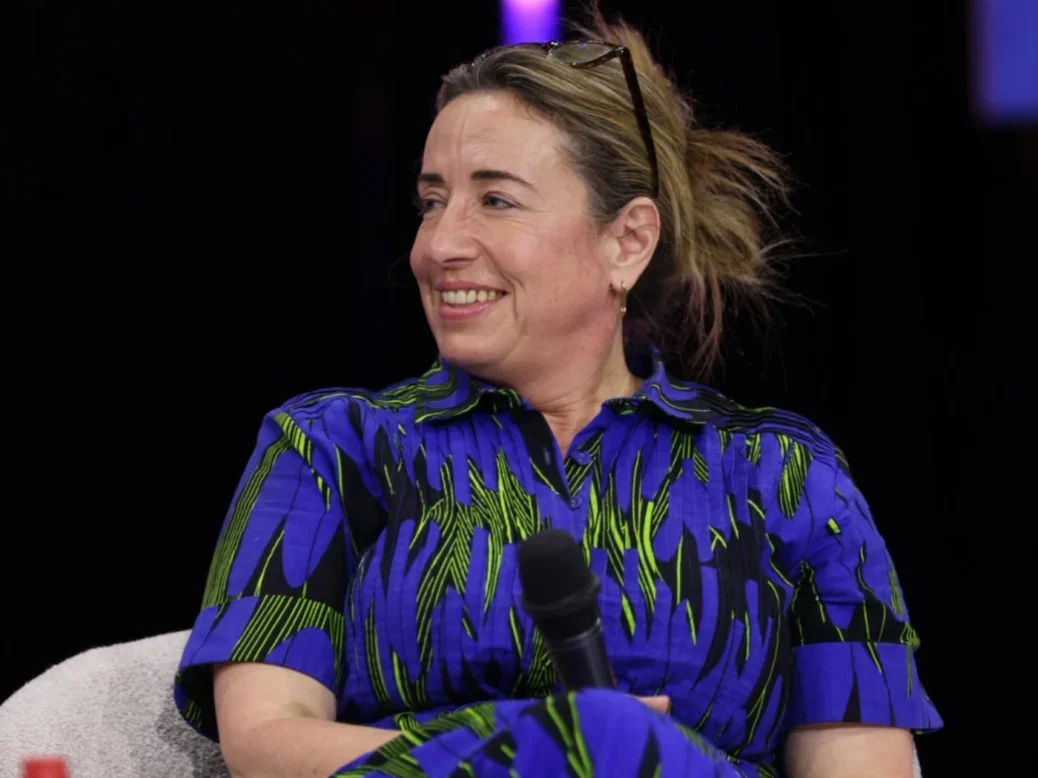
More than 80% of revenue coming from outside the UK at The Guardian did not exist ten years ago, editor-in-chief Katharine Viner has revealed.
Viner was speaking at the WAN-IFRA World News Media Congress about The Guardian’s ongoing strategy to become more global, more reader revenue funded, more human and more digital.
Axios reported last month that The Guardian’s US operation made revenue of $81.4m (£60.4m) in the year to 31 March 2026, up 25% year on year and the highest since the newsbrand launched in the US 15 years ago. US revenue came mostly from digital reader revenue (71%).
Some 8% of Guardian Media Group revenue came from outside the UK ten years ago, increasing to more than 40% today.
Viner told the Congress that in the year to 31 March 2026, digital reader revenue from people who pay regularly as “recurring supporters” and one-off donations was up 17% to £125m.
Two years ago in 2023/2024 digital reader revenue was £88m. In 2024/25 it grew by 22% to £107m.
Viner said: “From zero ten years ago, it brought in £125m last year… so it’s a really sensational model.”
She said readers contribute from around the world including in tiny or sparsely populated regions such as the island nation of Nauru, the Norwegian archipelago of Svalbard, Vatican City and Antarctica.
Guardian reader payments ‘not a transaction, it’s a choice’
Viner said: “I think one of the things that is quite subtle about the model is that, because you don’t have to give us money, you’re not a consumer in the traditional sense, you are more part of our community, so it’s not a transaction, it’s a choice, and that means you have a different relationship with us. So we found that that’s actually a more resilient model than I think with paywalls.
“At the same time, it’s still a very small percentage of regular readers who give us money, and so what we’re trying to do is make it as easy as possible for people who perhaps prefer a transactional relationship to give us money.”
Viner said people can pay specifically for products like the Feast recipe app, the main Guardian app, the Guardian Weekly magazine, or the daily newspaper itself.
“We try and make it as easy as possible for you to give us money while keeping the website open to all, which obviously has great social value when democracies are under threat and when news is increasingly something that people have to pay for.”
Kath Viner: ‘Facts on their own are not enough’
Viner also spoke about expanding further into non-text formats and looking at what a “Guardian news influencer” could contribute.
She said: “In terms of influencers, it’s really important not to be too sort of snobby about the kind of idea in general.
“Obviously some of them are not based in fact, and some of them you can’t trust what they tell you, but what they have done is do things that I think some news organisations have not, which is build close relationships with their audiences, they really understand the platforms they work on, and actually what I think we should be doing is is bringing our journalistic values together with that understanding.”
Viner added: “What we’re looking to do is think more about what is a Guardian news influencer, what would that look like, where you really could trust the information, but it was appropriate to the platform, and I think there are some news influencers who do it pretty well, actually, and lots who don’t.”
She said The Guardian is not seeing any impact from news avoidance in its data despite 46% of people in the UK and 42% in the US saying last year they sometimes or often avoid the news.
“I think that, on the contrary, people want a trusted source. I think the challenge for us now is to make sure that we give them the information they need to understand the world in ways that they can use, in the way that they’re familiar with. There’s no point giving a 4,000-word essay to somebody who only watches videos.”
She said The Guardian needs to “give them the news they need to understand the world, and then also perhaps give them ideas and new ways of looking at the world and nourishing journalism, so it’s not just facts. I really do believe that countering misinformation with facts, I mean, you have to have them, but it’s just not enough. Facts on their own are not enough.
“You have to bring stories and new ideas and different contexts and fresh perspectives. You have to approach people in different ways. You can’t just slam them on the table and say, well, here are the facts, because people will always provide another set of facts in that case.”
Speaking before Viner was New York Times chairman AG Sulzberger who issued a broadside against AI companies committing “brazen theft” of intellectual property.
Viner said in this context that “leaning into what makes us human, what makes journalism human, what makes us connect to each other, I think is our approach”.
Viner backed Sulzberger’s recommendation that publishers work together, noting that The Guardian is a founding member of the coalition SPUR which aims to create licensing standards that can be used by the whole industry.
Asked about how the UK Government is handling the copyright issue, Viner said: “I do feel that governments around the world seem so desperate for growth that they seem to think the words AI equals growth, and therefore they should just lean into that, but I think it’s much bigger than that for everybody… remember the creative industries as well as AI.”
Guardian boosting spend on legal team and physical protection
Viner also spoke about the pressure facing the Guardian newsroom from legal threats and abuse from public figures and everyday people.
She said: “Everyone’s boosting their legal teams, aren’t they?”
In August last year The Guardian secured a major High Court victory against actor Noel Clarke who had sued it for libel in relation to an investigation into sexual offence allegations against him.
Viner told the Congress that she felt the win has had a “really good impact on investigative reporting in Britain”.
Viner added that The Guardian has “obviously really upped our spending on protection in the field as well”.
“The terrible numbers of reporters and media workers killed in Gaza, in particular, shows that the press vest is no longer the protection that we thought it was, and I think that’s very frightening, and a sign of the times.”
Viner said Guardian journalists are no longer expected to post on social media, whereas years ago this was “actively encouraged”.
She said: “Even if you’re not a journalist who is in a controversial area, somebody coming on and humiliating you for something you’ve done will make you do it differently next time… once you start hearing voices in your head telling you you shouldn’t have done that… then you make bad decisions.”
Email pged@pressgazette.co.uk to point out mistakes, provide story tips or send in a letter for publication on our "Letters Page" blog
